






Vitalité et équilibre émotionnel pour un post-partum plus doux !
Pack New Mama : Forme et équilibre émotionnel
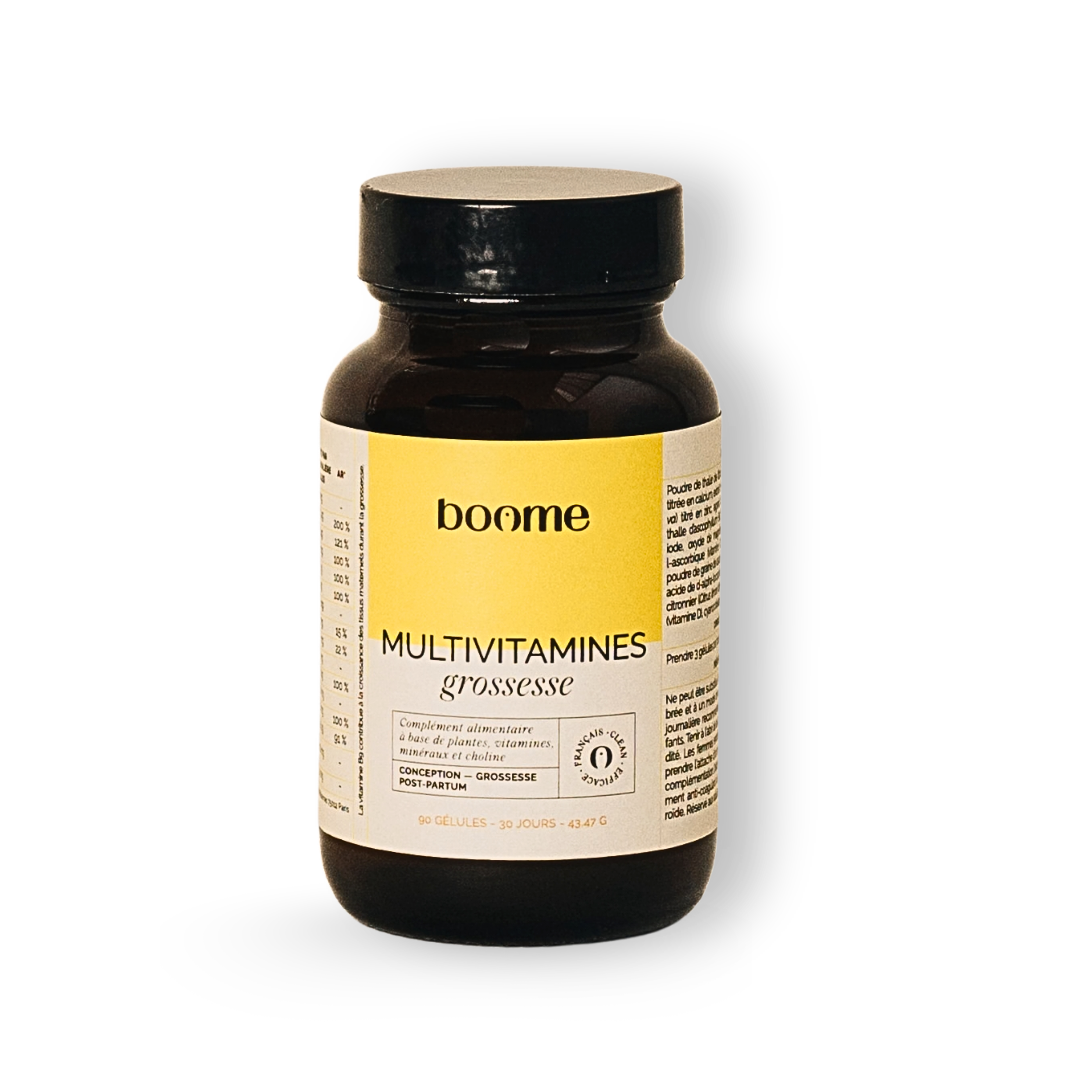
Duo essentiel dès l’accouchement à offrir ou à s’offrir : notre socle nutritionnel, Multivitamines Grossesse et Moral Boost pour un post-partum plus doux à un tarif avantageux. Compatible allaitement.
BOOME DAYS 🎂 -30% sur TOUT LE SITE !
Expédition le jour même (commandes avant 12h)
Frais de port offerts en France dès 100€
Paiement en 3x sans frais avec Alma et PayPal


 Formulé par des professionnels de santé
Également disponible en pharmacie

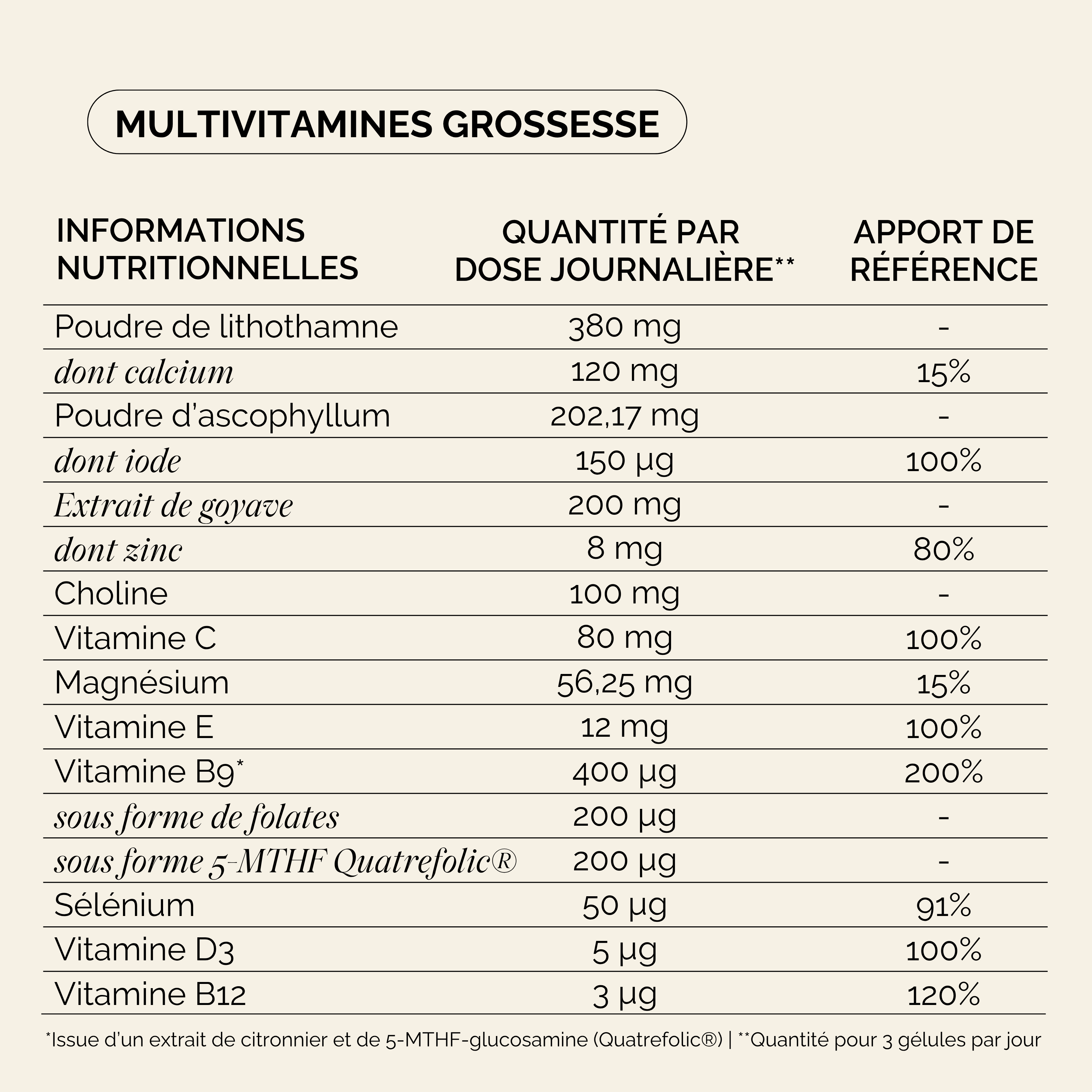
Composition :
Allégations de santé :
| Informations nutritionnelles | Quantité dose / jour | AR |
|---|---|---|
| Multivitamines Grossesse | ||
| Poudre de lithothamne | 380 mg | - |
| dont calcium | 120 mg | 15% |
| Poudre d'ascophyllum | 202,17 mg | - |
| dont iode | 150 µg | 100% |
| Extrait de goyave | 200 mg | - |
| dont zinc | 8 mg | 80% |
| Choline | 100 mg | - |
| Vitamine C | 80 mg | 100% |
| Magnésium | 56,25 mg | 15% |
| Vitamine E | 12 mg | 100% |
| Vitamine B9 | 400 µg | 200% |
| sous forme de folates | 200 µg | - |
| sous forme 5-MTHF Quatrefolic® | 200 µg | - |
| Sélénium | 50 µg | 91% |
| Vitamine D3 | 5 µg | 100% |
| Vitamine B12 | 3 µg | 120% |
| Moral Boost | ||
| L-tyrosine | 150 mg | - |
| L-tryptophane | 110 mg | - |
| Extrait de safran | 30 mg | - |
| Extrait de plantes | 60 mg | - |
| dont vitamine B1 | 1,2 mg | 109% |
| dont vitamine B2 | 1,2 mg | 86% |
| dont vitamine B3 | 2,4 mg | 15% |
| dont vitamine B5 | 2,3 mg | 38% |
| dont vitamine B6 | 1,2 mg | 86% |
| dont vitamine B8 | 36 µg | 72% |
| dont vitamine B9 | 48 µg | 24% |
| dont vitamine B12 | 1,2 µg | 48% |
| Poudre de fibre de pomme | 240 mg | - |
Contre-indications :
Pack New Mama : Forme et équilibre émotionnel
Minimum 81,01% d'origine naturelle
Compatible allaitement
Formulé par des experts
Made in France
Zéro ingrédient controversé
Ingrédients clés & études scientifiques
Le sourcing est notre priorité, la formulation notre métier. Chaque ingrédient a été sélectionné pour sa qualité et son rôle nutritionnel reconnu et grâce à la lecture de nombreuses études scientifiques (certains actifs sont brevetés). Une formule clean, sans ingrédient superflu ni additif controversé.

Ce que dit la science
Post-partum : La chute hormonale et l’équilibre émotionnel
La différence Boome
Formules sans compromis
Sans additifs ni ingrédients controversés, sans matières premières douteuses. Nos gélules sont obtenues par fermentation de tapioca et sont sans solvants.
Des experts à nos côtés
Nos formules sont co-formulées par des experts indépendants (gynécologue, pharmacologue, naturopathe etc...) pour vous offrir les meilleures combinaisons d'ingrédients.
Naturalité et qualité
Nos formules sont construites autour d'ingrédients issus de la nature (plantes, fruits, algues, champignons etc...) que nous marions à des actifs développés par la science, et parfois brevetés.
Sécurité
Fabrication française, traçabilité , respect de la règlementation, nous ne laissons rien au hasard. Nos produits finis font l’objet de contrôles aléatoires indépendants.
Prendre soin des autres
Nous reversons une partie de nos bénéfices à des associations qui oeuvrent contre la précarité des femmes. Nous adhérons au 1% for the Planet. Faire un achat Boome, c'est aussi soutenir celles qui en ont besoin.
FAQ

