Menopause and perimenopause: the “second spring” according to Chinese medicine

Sommaire
In brief
Menopause directly affects more than 4 out of 10 French women, and the perimenopause that precedes it can begin as early as 40. Beyond hot flashes, many women describe brain fog, fatigue, and a feeling of being "stuck". Traditional Chinese medicine offers an interpretation of these symptoms and sees this stage as a "second spring". Alexia Ginel, an acupuncturist midwife, explains this perspective and the natural approaches that can support women during this period.
At the very moment I write these words, there is a topic that directly affects 43% of the female population and will one day affect us all[1]. Yet, it does not make the headlines: it is spoken of in hushed tones, like a secret, among women who often say they were not "warned".
This topic is the final major stage of female physiology: menopause.
And although it is often overlooked in society, it is by no means discreet for the women who go through it. Indeed, according to a large-scale survey of 5,000 French women aged 50 to 65, 87% of menopausal women experience at least one symptom, and nearly 7 out of 10 have genitourinary symptoms, on average two to three[2][3]. All this in silence, confusion, often loneliness, sometimes fear.
When menopause enters women's lives
At 51, the average age of menopause, a woman is active and still leading a thousand lives in one! But the first changes often come much earlier: perimenopause (or premenopause), this transitional period that lasts several years, can begin as early as 40, sometimes even before. Irregular cycles, these new sensations and emotions that women do not always understand, announce the gradual end of their reproductive life. So they will have to deal with hot flashes, night sweats, urinary problems, and we talk less about them... fatigue, memory loss, brain fog, low libido... so many ailments that strike the woman who "does not recognize herself".
How to continue with daily life when you feel completely stuck? To assert your place at work when you are slowed down and they make you doubt your legitimacy? To thrive in your sexuality when you feel empty, sometimes even depressed?
Brain fog according to traditional Chinese medicine
In traditional Chinese medicine, women are considered to have a Yin nature and men, a Yang nature. To illustrate briefly, Yin is rest, introspection, cold, liquids, night... while Yang is associated with movement, outward expression, heat, day. These two aspects are complementary and the organs of the body function in interdependence: nothing is ever all Yin or all Yang! Harmony exists as long as the balance between the organs, and between Yin and Yang, is respected.
There are 5 organs and 5 viscera, but in Chinese medicine, the Kidney is the most important organ for women. We are not talking here about the "kidneys" we know in Western medicine, but of a Kidney as the "root of life", which governs heredity, fertility, birth, growth, sexual functions, willpower, determination, and much more!
And the Kidney is no less original, as it has the particularity of having a Yin part and a Yang part: it is called the "home of Water and Fire". Indeed, when the Kidney is balanced, its Fire warms, gives strength and the drive to act; at the same time, its Water nourishes the other organs and tempers the Fire.
With age, the Kidney essence decreases, leading to a decline in Kidney Yin. This decline is all the more favored by anxiety and fear, which impair the functioning of the Kidney. With Yin lacking, the Fire is no longer controlled: this is the most frequent picture to explain heat manifestations in the body (hot flashes, palpitations, sweating, drying of the skin and mucous membranes...) but also in the mind (insomnia, nightmares, mental agitation...).
When the Kidney is no longer balanced, other organs will be impacted: the Heart mainly, but also the Liver (irritability, tinnitus, dizziness) or the Spleen (heaviness of the body, weight gain, taste in the mouth).
The Heart is mainly impacted through its privileged relationship with the Kidney (we speak of the Kidney/Heart axis), because the Kidney Yin deficiency often leads to a Heart Yin deficiency, for which "brain fog" is one of the main symptoms. Indeed, the Heart houses the "Shen" (the spirit, consciousness, mental clarity) and its Yin function nourishes and calms the Shen. Like a protected bird (the Shen), supported on a solid branch (Heart Yin).
When this Yin function decreases, the Shen is exposed to heat: it is said that the spirit is no longer "anchored", the bird is like caught in the wind, disoriented. This leads to memory, concentration, and discernment problems: the famous brain fog. These symptoms cause anxiety, panic, and this stress further damages the Kidney and the Heart, like a vicious circle.
It is then appropriate to tonify Yin, calm the Fire, and soothe these deleterious emotions, because they have a strong impact on overall harmony. The woman in perimenopause will sometimes have to go through a form of mourning for her former identity and learn to master her fear and anxiety about the future. But this journey is not always easy in a society that is often indifferent to this subject.
Menopause, different views according to societies
In the West, the terms associated with menopause are: decline, atrophy, dryness, infertility... so many words that evoke the image of a desert. And sometimes it is true, the woman in perimenopause feels like she is in a desert, through her heat, her loneliness, her introspection. But the desert is not an end, it should rather be seen as a stage. Because menopause is one, and one of the most liberating stages: freed from her reproductive condition, the woman is finally free to open herself up to so many other things!
In Chinese medicine, this is called "the second spring" (and it is much more attractive than the desert): a new breath resulting from a new distribution of blood that once nourished the uterus and can now nourish the heart and the mind. The woman finally has the free choice to fulfill herself wherever she wishes, strong and wise from the experience of her life. It is essential for her to accept this passage, this new place, to find her new balance.
This is not always easy and acupuncture, phytotherapy, and micronutrition are natural allies to support the woman in this journey.
Natural methods to support you
According to Chinese medicine, many manifestations of menopause are linked to an excess of heat. Acupuncture then aims to rebalance Yin and Yang to support and alleviate these manifestations (palpitations, hot flashes, urinary problems, vaginal dryness, memory problems, insomnia, anxiety, irritability, anger...). Furthermore, acupuncture is a valuable tool to work on the impact of emotions on the body and to support the woman in her identity journey.
Several clinical trials have looked into this. In one of them, conducted with 209 women aged 45 to 60, the frequency of hot flashes decreased by about 37% after six months of sessions, while it was slightly increasing in women waiting for treatment. The benefit largely persisted six months after stopping the sessions, and the participants also reported better sleep and fewer memory and concentration problems[4]. This study did not include a placebo group: part of the effect can therefore be due to the support itself.
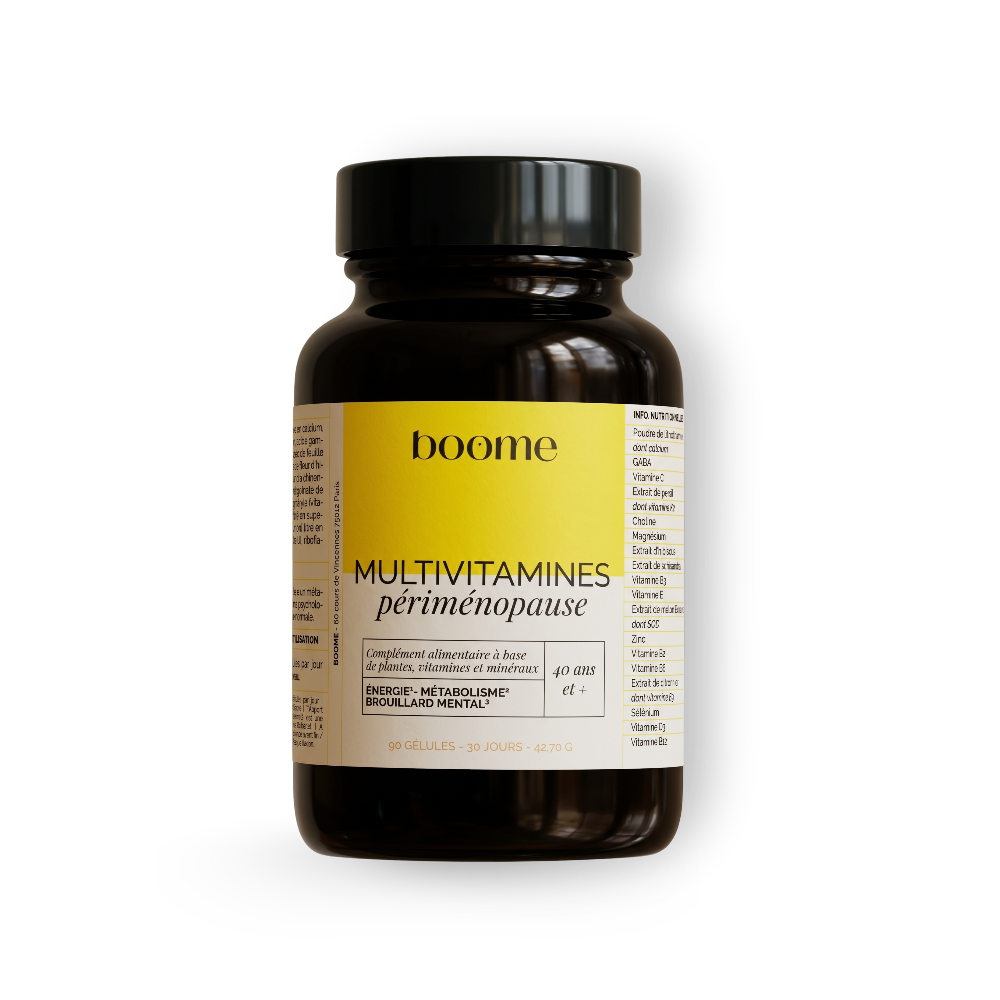
Micronutrition can also support this period. Some nutrients are the subject of claims recognized by European authorities: magnesium and vitamin C help reduce fatigue; magnesium also contributes to normal psychological functions; vitamin C helps protect cells against oxidative stress; zinc, finally, contributes to normal cognitive function. Other active ingredients, such as GABA, are the subject of promising research[5].
Breaking the silence
I therefore encourage all readers who feel the need to talk without fear among women about their ailments and their experiences, so that they are no longer alone in this stage and that menopause ceases to be a taboo subject. I also invite you to reach out to competent healthcare professionals to support you during this sometimes complicated period, so that the best of yourself emerges from it.
Menopause is not being put in storage, it is being put in a cocoon: it is up to you to emerge from it stronger!
FAQ
What is the "second spring" in Chinese medicine?
This is how traditional Chinese medicine designates menopause. It sees it as a new distribution of blood, which no longer nourishes the uterus but the heart and the mind. Rather than a decline, this stage is perceived as a new breath, where the woman can fulfill herself wherever she wishes.
At what age does perimenopause begin?
Menopause occurs on average around 51 years, but perimenopause, which precedes it and lasts several years, can begin as early as 40, sometimes even before. Cycles then become irregular and the first symptoms can appear.
How does Chinese medicine explain brain fog?
According to Chinese medicine, the decline of Kidney Yin with age often leads to a decline of Heart Yin. However, the Heart houses the "Shen", that is, the spirit and mental clarity. Less nourished and exposed to heat, the Shen is no longer "anchored", which translates into memory, concentration, and discernment problems.
Can acupuncture help in case of hot flashes?
Several clinical trials have looked into this question. In one of them, conducted with 209 women, the frequency of hot flashes decreased by about 37% after six months of sessions, with a benefit that largely persisted six months after stopping[4]. Talk to a healthcare professional trained in acupuncture.