

Oily hair and skin before your period: what your hormones are telling you
Sommaire
Key takeaways: Your hair and skin follow the hormonal logic of your cycle.
- Your sebaceous glands and skin have hormone receptors: they react directly to variations in the menstrual cycle.
- Estrogen slows down sebum production: hair and skin are at their best during ovulation.
- Testosterone stimulates sebum — an effect particularly felt just before menstruation, when estrogen levels drop.
- The role of progesterone remains debated by dermatologists: its direct link with excess sebum has never been scientifically proven.
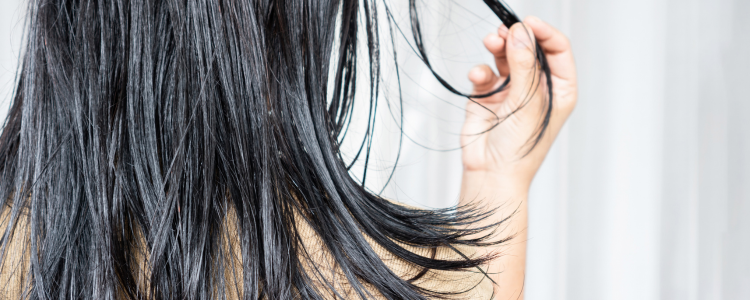
Some days, your hair is (very) worth it. Other days, it clearly decided to sabotage your morning. Good news: it's not a matter of bad luck, but of your cycle, and there's an explanation. To find out where you are in yours, head to our guide on how to calculate your menstrual cycle.
Why is my hair greasy before my period? Blame the progesterone + testosterone duo
If your hair becomes greasy again the day after washing in the days leading up to your period, the most common explanation points to a hormonal duo: progesterone (still well established since ovulation) and a second small testosterone peak.
The idea that progesterone stimulates sebum production is widespread, including among several healthcare professionals. However, it deserves to be qualified: Indian dermatologist Dr. Sangita Ghosh, in a reference review published in the Indian Journal of Dermatology, reminds us that this link has never been formally demonstrated experimentally in humans, and that progesterone even acts, biochemically, as a competitive inhibitor of the enzyme responsible for sebum activation by testosterone, a mechanism that should rather inhibit it [1].
This is what American dermatologists John S. Strauss and Albert M. Kligman had already observed in the 1960s: the effects of progesterone on the sebaceous glands vary according to studies and do not follow as simple a pattern as is often thought [2].
What is solidly established, however, is that testosterone stimulates sebum production: once converted by the skin into DHT (its most active form), it prompts the sebaceous glands to produce more. And just before menstruation, its effect is particularly felt: while estrogen and progesterone levels drop, testosterone levels remain stable, which, in comparison, gives it more influence on the skin and scalp. This link between hormones and skin is also confirmed by a large study conducted by Prof. Christos Zouboulis involving more than 17,000 women: it shows that women with irregular cycles more often suffer from acne or rosacea [3].
💡 Smart tip: During this period, forget ultra-nourishing masks (your scalp doesn't need extra help to get greasy) and opt for a purifying, lighter shampoo.
Why is my hair at its best during ovulation? The secret to "Good Hair Day"
Conversely, around ovulation, estrogen levels are at their peak, and for once, they work in your favor. Unlike other hormones, estrogen has a rather calming effect on sebum: a recent study shows significantly lower sebum production in the ovulatory phase than in the early luteal phase [4]. At the same time, a slight testosterone peak counteracts what is happening. The result: an almost perfect balance between a hormone that inhibits sebum and another that activates it just enough to give volume and shine. The winning combination.
The personality profile of the 3 hormones that decide your good or bad hair day
| Hormone | Effect on sebum / hair | What science says |
|---|---|---|
| Estrogen | Anti-seborrheic effect: inhibits sebum production, lighter and shinier hair | Well-documented effect; a study by dermatologist Emanuela Camera (San Gallicano Dermatological Institute, Rome) with Prof. Christos Zouboulis (Brandenburg Medical School) confirms a lower sebum production peak in the ovulatory phase than in the early luteal phase [4] |
| Progesterone | Role long presented as stimulating sebum | Link not experimentally demonstrated in humans; biochemical effect sometimes inverse (competitive inhibitor); still debated [1][2] |
| Testosterone | Stimulates sebum production, with a peak around ovulation and a relative dominance at the end of the cycle | Stimulating effect well established in the literature on androgens; the ovulatory peak is confirmed by a hormonal monitoring study on 414 women (2024) |
This same hormonal trio also explains variations in female libido throughout the cycle.
And what about skin?
Your skin follows the exact same hormonal logic as your hair, phase by phase, which is logical, since the same hormones control the sebaceous glands. Estrogen also plays a broader protective role on the skin: beyond its effect on sebum, it contributes to maintaining skin thickness and collagen production, a mechanism documented for estrogen deficiency during menopause, and which can reasonably be extrapolated to finer variations in the cycle [5]. Other body signals also evolve phase by phase, such as the evolution of cervical mucus throughout the cycle.
💡 The right reflex: schedule active treatments (retinol, exfoliants, peels) during the follicular phase and ovulation, when the skin is most tolerant, and lighten your routine (both skin and hair) from the second half of the cycle.
How to adjust your hair routine according to your cycle phase
| Cycle phase | What happens hormonally | The routine reflex |
|---|---|---|
| After menstruation, before ovulation | Scalp is well-balanced | Space out shampoos, no guilt |
| During ovulation | Estrogen peak, slight testosterone peak: optimal balance | Nothing to do, your hair manages itself |
| After ovulation | Progesterone sets in, testosterone begins to decline | Wash more often, lighten treatments |
| Just before menstruation | Progesterone and estrogen drop, testosterone remains stable: relative androgen dominance | Purifying shampoo, light products, no extra nourishing treatment |
| During menstruation | Hormones at their lowest | Fatigue and mild inflammatory climate (prostaglandins): focus on comforting care and a diet rich in iron and zinc |
The same principle applies well beyond the hair routine: your energy and physical performance follow the same logic, as explained in our article on organizing your sports practice according to your cycle.
When it's no longer just "a matter of cycle"
Some hormonal imbalances go far beyond a simple bad hair day, and then, we stop joking:
- PCOS (or PCOSS): The excess androgens it causes are associated with alopecia that affects the top of the head. A reference meta-analysis conducted by Professor Enrico Carmina, an endocrinologist, on behalf of the Androgen Excess and PCOS Society, estimates the prevalence of this alopecia at 28% in women with PCOS (confidence interval: 22 to 34%) [6]. The link between excess androgens and hair loss is also widely documented in the literature on the mechanisms of androgenetic alopecia [7].
- Hypothyroidism: can make hair softer, more brittle, with more pronounced shedding.
- Puberty, postpartum, perimenopause: these major hormonal shifts can also affect hair density and texture, sometimes more lastingly – we detail what happens in our article on our hormones during perimenopause.
⚠️ The real alarm signal: a real loss of density (not just a different texture on a given day), especially on the top of the head, or hair loss that lasts several weeks. See a doctor and, if necessary, get a blood test.
What we remember
Your hair doesn't hate you personally, even if everything suggests otherwise on a bad morning. It faithfully follows the hormonal logic of your cycle: estrogen in regulator mode, testosterone in activator mode, progesterone with a still debated role, without ever warning you in advance. Once you've identified this logic, you can adjust your routine.
Frequently asked questions
Why does my hair get greasy faster after ovulation?
The most common explanation points to progesterone, which takes over after ovulation. Its exact role on the sebaceous glands is still debated by dermatologists; the small peak of testosterone that accompanies it, however, has a well-established stimulating effect on sebum.
Does the pill change things?
Yes: by pausing the natural hormonal cycle, the pill tends to smooth out these variations. What is described here mainly concerns cycles not treated with hormonal contraception.
When should you worry about hair loss?
If the loss of density is real (not just a different texture on a given day) and persists for several weeks, it is best to talk to a healthcare professional.
Sources
Related Products


Produits associés
Read more
Fatigue is one of the most common symptoms of perimenopause, affecting many women between 45 and 50 years of age. It is mainly explained by fluctuations in sex hormones, estrogen and progesterone, ...
Brain fog is one of the most common and least recognized symptoms of perimenopause. It is not a disease or a sign of cognitive decline: it is a reversible effect of hormonal fluctuations on the bra...