



Postpartum: 3 days, 3 months, or 3 years?
Sommaire

When pregnant, childbirth is often perceived as the finish line of pregnancy. And then, suddenly, surprise: you enter the adventure of postpartum. Sometimes, this period can feel like paradise. We are cradled by hormones and the first moments with our baby. We resume our daily activities. And in no time, postpartum is behind us. In short, exactly what we had imagined. Great!
And sometimes, the postpartum period takes a different turn. We're not in super good health. Milk production proves difficult. Anxiety disorders can appear. In short, it's not quite the rosy period we hoped for. At the maternity ward, the midwife had told us that postpartum would end after a few weeks. But we feel like it's dragging on. And it's hard.
Does that resonate with you? It's normal. Because one topic is debated: how long does postpartum last? We tried to answer this complex question for you. A focus on the different perspectives that characterize this period, its symptoms, and our advice for experiencing it as best as possible.
How long does postpartum last?
Postpartum period: what medicine says
Let's take things in order. First, what does medicine say? According to the World Health Organization, postpartum (or "post-childbirth period") is nothing more than the period immediately following childbirth. Generally, it lasts 6 to 8 weeks, or about 45 days. Why? Because that's how long the uterus needs to return to its original shape and position. This period therefore begins as soon as the placenta is expelled and ends on the first day of menstruation's return.
But already, within the medical community, some professionals add their nuances, as explained by Harmonie Santé magazine. It states that gynecologists Mattea Romano and Alessandra Cacciatore define the postnatal period in three distinct phases:
- the acute phase (6 to 12 hours after childbirth);
- the subacute phase (2 to 6 weeks);
- the delayed postpartum period (up to six months after birth).
You see where we're going with this: postpartum is much more complex than what you find in a dictionary.
Postpartum period: what women say
Because yes, there is the postpartum seen by medicine... And ours. The one we live, which belongs to us, which reflects our story. An experience that is both universal and so unique. The one that turns everything upside down: the body, the couple, the family, work. Without consensus.
So, how long does it last? The real answer is that there isn't one. It can extend over several months... Or even three years, as midwife Anna Roy claims. Does that seem long to you? It's normal. But don't forget that giving birth generates a multitude of physical and physiological cataclysms, which can sometimes persist (we'll talk about that right after).
That's why there's such a significant discrepancy between medical perspectives and the experience of new mothers. Because we tend to focus on the immediate symptoms following the baby's birth. Yes, your uterus returns to its original size after a few weeks. But no, you don't become "who you were before" in a snap of your fingers. It's much more complex than that. Many women, by the way, refer to their postpartum as a "4th trimester."
Anna Roy and other feminists, like Illana Weizman, are therefore advocating for a long-term view of postpartum for expectant mothers. And to thus combat the injunctions to immediate happiness that result from it.
The symptoms of postpartum
As you will have understood, many elements can influence the duration of postpartum. And notably physical and psychological symptoms. Here are a few (non-exhaustive list).
Postnatal period: physical changes
Immediately after childbirth, the same symptoms that characterize postpartum from a strictly medical point of view are regularly observed. The two most common discomforts remain:
- Afterpains: uterine contractions felt after giving birth. This is the muscle working to return to its original shape.
- Lochia: bleeding (like heavy menstruation) that begins after the expulsion of the placenta. It remains very abundant for the first few days, then decreases over the weeks, to disappear completely.
- Milk let-down: breasts swell, breastfeeding is preparing! But it can pull and hurt a little.
- Stretch marks: they will fade over time.
It can also happen that the vagina burns a little if you have suffered some lesions or an episiotomy. Don't panic, it will quickly return to normal.
Your belly will remain rounded for some time. It carried your baby for nine months, it cannot become completely flat in a split second! And that's normal. So, don't feel guilty, and most importantly... Don't start exercising or dieting to lose weight. Do not resume physical activity without the approval of your doctor or midwife. Spare your pelvic floor!
Psychological changes
As you will have understood, the body changes. But so does the brain. And the psychological upheavals linked to postpartum often manifest through two very different states, which are still not talked about enough.
Baby blues
First, there's the baby blues. You've probably heard of it. What exactly is it? Well, it corresponds to a cocktail of emotions linked to all these physical, psychological, and hormonal changes. Which, in turn, is due to childbirth. Quite a story! This state lasts about 15 days and affects the majority of women. It happens a few days after birth, and the new mother can then:
- feel like crying "for no reason";
- feel tired;
- be very irritable or prone to mood swings;
- lose her bearings...
- ...or her self-confidence.
We grant you, the baby blues can quickly be intimidating. But it remains harmless. Let's add that it disappears on its own. However, if it lasts more than two weeks, talk to your doctor or midwife. It may be postpartum depression.
Postpartum depression
Not to be confused with the baby blues, therefore. And yet, such a common mistake! According to Les 1000 premiers jours, nearly one in five mothers suffers from postnatal depression. Often, it sets in between the baby's first and second month. So, when should you consult? Basically, when the baby blues persists and signs. The symptoms remain largely the same:
- anxiety;
- confusion;
- headaches;
- insomnia;
- irritability.
The problem is that it's difficult to diagnose. Why? Because women tend to keep it quiet. They feel guilty about this state of discomfort, feel remorse, and consequently prefer not to talk about it with their loved ones or a health professional.
Nevertheless, the consequences of postpartum depression on their well-being and that of their child can be terrible. So, our advice: talk to someone you trust. Don't be ashamed. You are not alone!
Let's also add that this illness does not only affect women. It is still a rather taboo subject, but paternal postpartum depression also exists. It affects nearly one in 10 fathers, and deserves just as much to be brought up for discussion.
Living well through your postpartum period
In France, many initiatives help support new mothers through their postpartum. However, few women know this and go through all these discomforts alone. So remember that several free services can support you during this special period. And this, well before the famous 6-week check-up.
The Prado device
Once home, you are entitled to two or three midwife visits within the first twelve days of your child's life. This is the Prado device for returning home, and it's free. It is offered primarily to mothers who have an early discharge from the maternity ward (24-72 hours postnatal for vaginal delivery, and 96 hours for C-section). So, take advantage of it.
The CAF
Family allowance funds (CAF) and certain associations also finance home help hours. These arrangements are put in place in case of a change in situation. This includes, of course, the birth of a child. This can really help you overcome temporary difficulties.
Mother-baby units
Some hospitals have a mother-baby unit, to help those who struggle to bond with their baby or who suffer from postpartum depression.
The 6-week check-up
Of course, the postnatal consultation with your gynecologist, or with the midwife from the maternity ward. It takes place between 6 and 8 weeks after the baby's arrival. This is where you will review your health status. The professional will, for example, check your scars (if episiotomy, tear, or C-section). But you will also be able to confide in them about your psychological well-being! So, talk about everything: your joys, your anxieties. The (sometimes complicated) experience of birth. Your hesitation between breast milk and infant formula. Your desire, or not, to resume sexual activity. In short: all your difficulties.
Muscle rehabilitation
Don't neglect your perineal and abdominal re-education sessions (we tend to forget that one)! These will allow you to:
- regain super abdominal muscles;
- promote a well-toned pelvic floor;
- greatly limit problems you don't want to have in your life (like, for example, urinary incontinence).
After a few sessions with a physiotherapist who will teach you how to properly contract your perineum, you can equip yourself with a perineal probe to continue your rehabilitation at home. The probe is connected via Bluetooth to your smartphone, allowing you to perform the exercises in the form of mini-games, at home, at your own pace.
They will also help you resume physical activity quickly. All good, in short!
The Post-Partum range at Boome
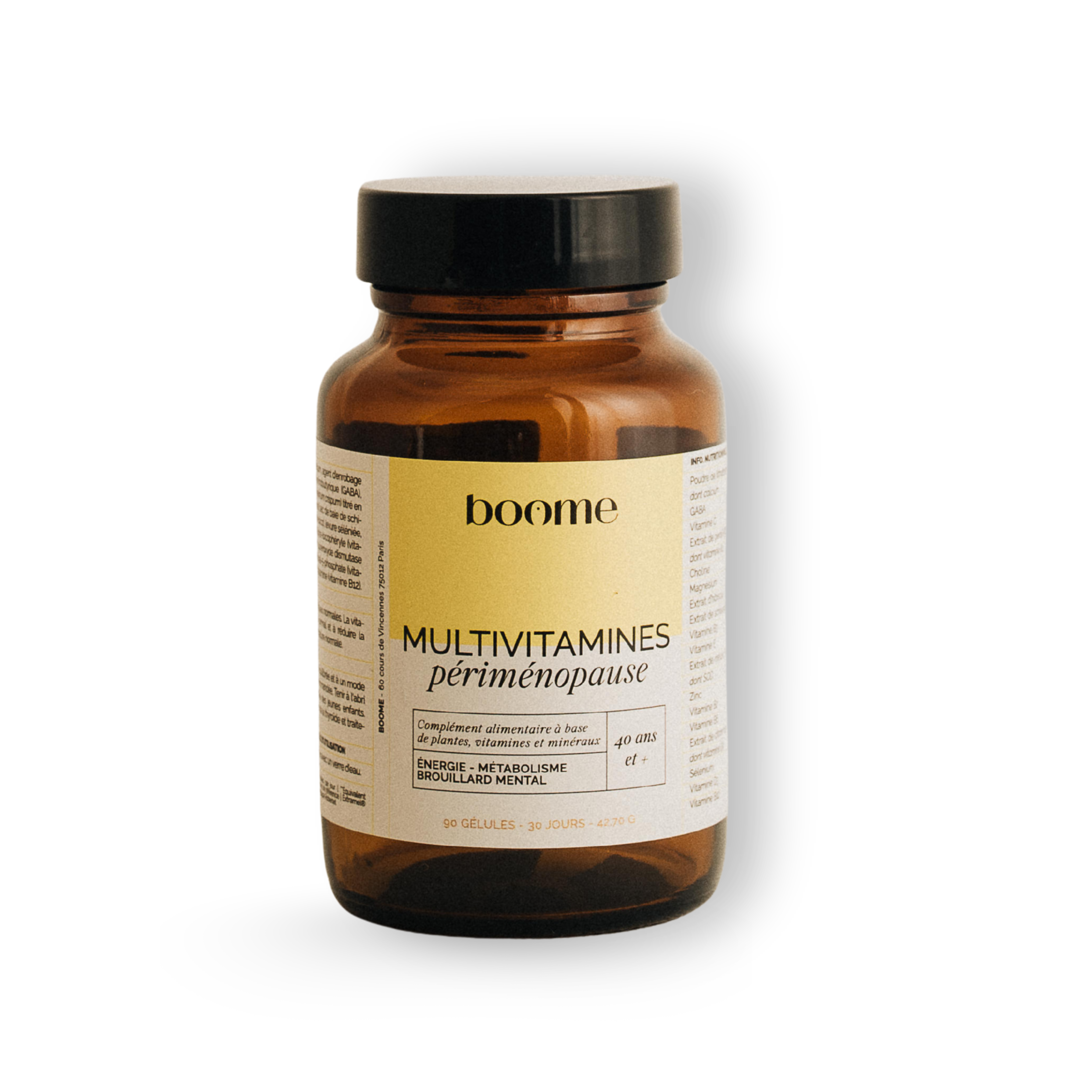
At Boome, we've noticed how often the new mother takes a back seat once her child is born. But we haven't forgotten you! And we wanted to support you as best as possible during this very special period. That's why we created Moral Boost, a food supplement against fatigue and stress made from plants, vitamins, and amino acids. All of it 100% natural and without additives, of course. A complete range of products specially designed to help you navigate the few months after your delivery with peace of mind.
Our vitamins will be your best allies for:
- boosting your mood;
- reducing your fatigue;
- improving your stress resistance;
- strengthening your body.
In short, they will provide you with physical and emotional support, essential to counter the hormonal drop caused by the postnatal period.
So, what to remember from all this? Well, that postpartum represents a life moment as unique as it is complex. That it defies any simplistic definition. That each experience remains entirely personal, with its joys and challenges. And most importantly, that it extends far beyond established medical limits. It is by recognizing this diversity and offering appropriate support to women that we can accompany them as they deserve in this extraordinary adventure.
Stay connected with us for more tips, tricks, and news about motherhood! Follow our adventure on Instagram and join our community of (future) mothers.
Produits associés


Produits associés
Read more

Welcome to the fascinating world of the luteal phase, a crucial stage of the menstrual cycle that is often overlooked. The female hormonal cycle includes 4 major phases: menstruation, the follicul...

“Do I really need a prenatal vitamin?” This is a question that we can legitimately ask ourselves during pregnancy or pre-pregnancy. Our mothers or grandmothers often told us that in their time...

