

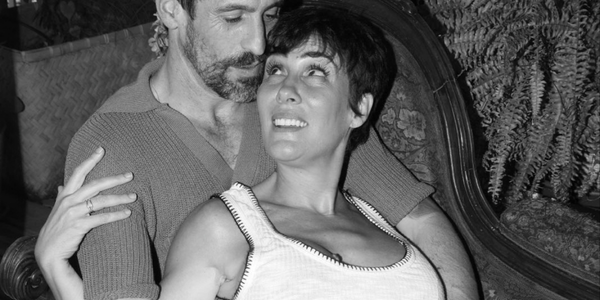
Noémie de Lattre, pregnant at 49: "To tell yourself that it's possible"

Sommaire
In short: At 49, author and artist Noémie de Lattre is expecting her second child, a baby boy, thanks to an egg donation. She talks about grieving the loss of a large family, the options considered before deciding on this path (adoption, natural conception, assisted reproduction), the wave of messages of support she receives, and the questions about legacy that this pregnancy raises for her.
Can you introduce yourself in a few words? Who is Noémie today: the author, the actress, the feminist artist, the mother…?
I'm Noémie de Lattre: I'm an artist, I'm the mother of an 11-year-old boy, and I'm about to become a mother again, for the second time, at 49.
I had my first child at 37, and that was already a "geriatric" pregnancy. But I loved everything about it: I loved being pregnant, I loved giving birth, I loved breastfeeding, I loved being a mom. I really loved it all. I was keen on having a large family, I wanted to start again right away: I felt like I was made for it.
When did you allow yourself to believe that this pregnancy was possible? If you feel like it, can you tell us what you went through: the expectations, the possible medical support, the doubts, the choices… and what allowed you to go for it?
Unfortunately, the man I was with at the time didn't want the same thing at all. It was a painful grief, the loss of a second child and a large family, a grief I didn't really process at the time. I told myself: after all, we're a couple, we love each other, that's one thing; he doesn't want any more children, I do, I'll have them elsewhere — alone, or with a gay boyfriend, there are plenty of possibilities. I started embarking on this adventure, he wasn't very keen, but I told myself it was a project that was close to my heart and that he couldn't stop me from doing it. Finally, he left me a few years later, and I told myself: okay, now I'm really free to carry out this project.
In fact, even before my first child, the idea of separating maternal love from romantic love, of separating my life as a mother from my life as a woman, was already something that had been on my mind. I had already done some research, I had already talked about it with friends. It didn't happen. I am very attentive to the messages of the universe, to the flow, to the energy, and I really felt that the universe was not pushing me in this direction. I turned 42, 43, 44, 45, and at 45 I told myself: too bad about this second pregnancy, this large family, it's over. But this time I was living a life that suited me very well, very happy with my only son, so this grief was not painful at all.
And that's where life is wonderful: at the very moment I told myself "it's very good like this", I fell madly in love with a man 11 years younger than me, with a project of a large family. I told him: a large family, it's going to be complicated, but we can think about it. We didn't know how we were going to do it. He said this very beautiful sentence: "there are plenty of ways to make a family, I know you are the woman of my life, it's with you that I want to do this, and we'll see how".
The first option he told me about was adoption. I didn't need to think long: it's something that had already crossed my mind, and I don't feel capable of it. Already with a natural child, I have a whole lot of questions about legitimacy — am I a good enough mother, do I deserve it. So if this child doesn't come from my body too, I was afraid of never being good enough, of never being up to it, and also afraid of not loving them as much as my natural child. Too much fear: adoption, no. We also considered that Raphaël make a child on his own, with a woman with whom he would not be in a relationship — I would then be the stepmother of this child, just as he is the stepfather of mine.
We still tried to work without a safety net, telling ourselves that nature might smile on us: I had done a whole battery of tests at 47, and the results were very positive, I was in perfect health, I still had eggs. But committing to something completely natural meant starting to calculate, to make love to procreate, on demand, and that, I really didn't want to. If I hadn't been the age I was, we wouldn't have even thought about making a child now: we wanted to live our love story like that, for years to come. Without the biological clock, the question wouldn't have even come up; another reason not to embark on something very invasive that takes up our time and mind.
Then there was IVF. With my own eggs, I have plenty of friends who have embarked on this journey, and it's a real warrior's journey: months and months of injections, hormones, medical tests, counting, taking temperatures. It costs a fortune, it takes a crazy amount of time, and for a result, at the age I was, there was a 0.6% chance of success. Our entire life was going to revolve around this. And taking hormones didn't suit me: I'm rather natural, I always prefer to avoid allopathy and I try to put as few things as possible into my body that are not produced by it or by nature.
It was at that moment that a friend, who had had a first girl naturally at 37, told me she was expecting her third child at 52 through egg donation, after a second one already conceived this way at 50. Everything was going well for her, she was happy. I talked about it with Raphaël, and it was decided in four seconds: it was obvious. Between the time we called a first laboratory to inquire and the time I found myself with a positive pregnancy test in my hand, a month and a half had passed.
A pregnancy at 49 still seems to provoke a lot of reactions. What has this pregnancy revealed about the way our society looks at women, their age, and their maternity even today?
I was very, very surprised by the reactions. I expected either indifference or judgment — "but you're crazy, you're irresponsible, it's against nature" — I expected something rather unpleasant. And actually, it's incredible: I didn't expect such a wave of solidarity, happiness, joy. I receive every day, several times a day, in the street or on social media, testimonies from women who come to tell me thank you, that it gives them hope, inspiration. It opens something for them: to tell themselves that it's possible.
I communicate a lot about the fact that it costs money, that it's not a solution accessible to everyone, that it's not universal, that it remains a privileged solution. But I really receive tons of testimonies that talk about hope, possibility, opportunity. I don't feel judged at all, I feel supported. And me, who no longer has a family (my parents, my brothers and sisters are all dead), I have the impression that the women of my community replace this family: they live this pregnancy with me, they are aware of everything, the ultrasound, the fact that it's a little boy. I feel useful too.
You spend your life questioning, unpicking, denouncing the injunctions made to women. Has this pregnancy come to shake some of your own certainties?
My first pregnancy was a real explosion of awareness, very brutal: the opposition between the joy of what I was living in intimacy and the brutality of society towards women in general, pregnant women in particular, the brutality of gynecology and obstetrics. I have already talked a lot about it, and I still talk about it in my show, in my books.
This second pregnancy, on the other hand, did not come to shake this awareness — on the contrary, it came to confirm and reinforce it, in an idea of empowerment and possible freedom of women. I turned to an egg donation, in a project of love, but for other women, there is also the possibility of double donation, of making babies alone — which, in terms of empowerment, is still something very strong.
With the years, we often gain a form of freedom. What does becoming a mother today allow you to experience that you might not have experienced during your previous pregnancy ten years ago? And conversely, what does this maternity ask you to go through, that is rarely imagined?
For my first pregnancy, at 37, I was already in an established life, I already had means, and I lived it with a lot of freedom. I can't say that I have more today... I even have less: I was financially much more comfortable ten years ago than today, so I think it will be harder materially. But everything is fine.
What is really new, on the other hand, is that my first child was the fruit of my genes and those of my partner, conceived naturally: I had nothing to question about maternity, about what it means to bring a child into the world. Here, the fact that this child does not carry my genes (and that my parents being dead, they will never have known them and will have nothing from them) raises a lot of questions about transmission, about what it means to bring a child into the world. I went through a lot of questioning, sometimes heated, especially during the first trimester. It's no small thing, and I address the women who carry this project: prepare to go visit things deep inside you, to do real work on yourself, to face the fact of carrying a child who comes from another family, another story, another genetics, another heritage, another matrimony.
When I was expecting my first child, precisely because everything was natural, I remained despite myself quite anchored in the traditions of heredity, in the idea that it's "my child, the fruit of my womb". It took me time, I think it was when my family started to die, when we went through big dramas, my son and I, that I really started to think about gentle parenting, non-violent communication, the adultism of our societies, and my relationship with my child. It was a long road. With this pregnancy, rich in this first experience and forced, by the genetic difference, to ask myself all these questions, I am really in a different approach from the start.
Finally, I would like to ask you something very simple: when your child reads this interview in twenty years, what would you like them to understand about the woman you were at the time you were expecting them?
Know that right now, I am five months pregnant, and I am already trying to give you all your agency, all your sovereignty, all your independence, all your autonomy. You are not my child, you do not belong to me. You are a full individual, who exists freely, who develops in my belly, and to whom I will give all the love and all the care necessary to grow up in happiness and fulfillment.
Know that I am already trying to respect as much as possible your individuality, who you are, you, independently of me. And I already love you.
Read more

Key takeaways Polycystic Ovary Syndrome (PCOS) is now known as PMOS, for "Polyendocrine Metabolic Ovarian Syndrome." The change was announced on May 12, 2026 [1]. The former name was inaccura...
Key takeaways The "90-day rule" is based on the maturation time of gametes: about 72 to 74 days for a sperm cell [1], and about 85 days for an ovarian follicle to reach ovulation, within a lon...

