



Baby's gender: how and when to find out?
Sommaire
Girl or boy? That's THE question most expectant parents ask themselves from the first signs of pregnancy. As soon as the test is positive, bets are already being placed. Tips circulate, and impatience grows day by day. But what really determines the baby's sex? And most importantly, when can you be sure? You'll find out in this article. Let's go!
What determines the baby's sex?
Contrary to some popular beliefs… The dice are cast at fertilization! Let's get a little science lesson in.
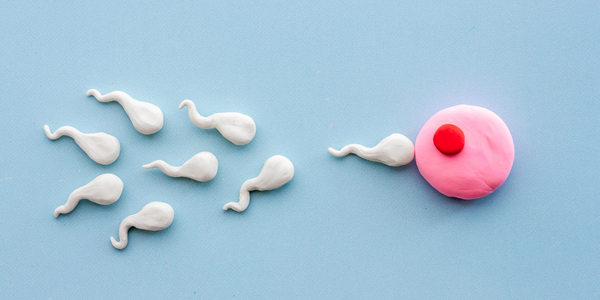
Your baby's sex is determined by the father's sperm, which carries either an X sex chromosome or a Y chromosome. The mother's egg always carries an X chromosome. So, if a sperm carrying a Y chromosome fertilizes the egg, the baby will be a boy (XY). Whereas a sperm carrying an X chromosome will result in a girl (XX). Are you still with us? Great! Remember that the expectant mother plays no direct genetic role in the choice of sex. The decider… is the male chromosome!
Then the baby's genitals begin to develop during the first weeks of pregnancy. However, they can only be differentiated starting from the 8th week of pregnancy. This is because all embryos initially have an identical genital structure, capable of developing into either sex.
In boys (XY), under the effect of certain hormones (like testosterone), these embryonic organs gradually transform to become male sexual organs.
In girls (XX), in the absence of these hormones, the genitals spontaneously develop into their feminine form. This process, entirely guided by the genes present on the sex chromosomes, is completed around the 14th week of pregnancy. A true test of patience for some expectant parents!
What is the probability of having a girl or a boy?
In theory, every pregnant woman has an almost equal chance of having a girl or a boy, meaning a 50% probability for each sex. Because, as you've understood, sex determination is primarily a matter of chance, linked to the sex chromosome brought by the sperm.
However, there is no shortage of misconceptions or controversial methods for choosing the sex of one's child. Despite this, no natural technique or popular "recipe" has proven truly effective in influencing these probabilities.
Nonetheless, if we delve a bit into the facts, expectant mothers seem to be more likely to carry boys than girls. According to INED, there are on average 105 male births for every 100 female births. How to explain this difference? To date, it remains difficult, although it could be due to greater mobility of sperm carrying the Y chromosome, which would slightly influence the chances of having a boy rather than a girl.
But be careful, take this information with a grain of salt! Especially since this difference remains very minimal. And ultimately, pregnant women still have an almost equal probability of having a girl or a boy.
When and how can you find out your baby's sex?
This is often THE moment awaited by expectant parents… The gender reveal of their child, the famous gender reveal! Thanks to medicine, we can now know it relatively early. And with certainty, please.
Reliable medical methods to know the baby's sex
Morphological ultrasound: the most common method
Generally, you find out your baby's sex during the 2nd trimester pregnancy ultrasound. Performed between the 18th and 22nd week of amenorrhea (the 5th month of pregnancy), it is also called a "morphological ultrasound." Why? Because it clearly identifies the external genitals of the fetus and recognizes the sex on ultrasound with good reliability.
At this stage, the margin of error is estimated to be less than 5%. Which is very low… So, very reliable! However, this accuracy depends on several factors:
- the quality of the equipment;
- the practitioner's expertise;
- but also… the baby's position during the exam.
Indeed, if this little rascal (male or female) is in a bad position during the ultrasound (e.g., legs crossed, back turned, or umbilical cord obstructing the view)... You might leave without knowing their sex. And have to wait until the next ultrasound. A major source of disappointment for some expectant parents.
However, an early first-trimester ultrasound does not allow for reliable prediction. The genitals are not yet developed enough at this stage.
Blood test (NIPT): knowing the baby's sex from 10 weeks
In some situations, where the expectant mother has pregnancy anomalies, the baby's sex can be known earlier thanks to NIPT (non-invasive prenatal testing), possible from the 10th week of pregnancy. What does it involve? Fetal DNA circulating in the pregnant woman's blood is analyzed, which is why it is also called a blood test for the baby's sex. This highly reliable test is generally offered when there is a risk of chromosomal abnormalities. It is not a routine examination solely for determining sex.
Amniocentesis: absolute certainty
Another possible examination is amniocentesis, performed between the 15th and 18th week. This allows parents to know the baby's sex with certainty. During this procedure, the baby's DNA, contained in the amniotic fluid, is directly studied. Nevertheless, amniocentesis carries risks of miscarriage, even if they remain low. It is therefore reserved for very specific cases requiring a precise diagnosis.
Signs of pregnancy, girl or boy: grandma's tricks to try for fun
Too impatient to know your baby's sex? We understand! There are many popular tricks to guess the baby's sex, girl or boy, from the first months of pregnancy. Or even from the first few weeks, for the most playful among you.
Among them, food cravings are high on the list: a sweet tooth would indicate a girl, while a craving for salty foods would announce a boy.
Another widespread trick: the shape of the belly, which is said to be revealing. Are you sporting a round belly? That would be a sign of a girl. Is it rather pointed? That would indicate a boy…
The pendulum test is also often cited. What is it? It consists of suspending a wedding ring above the expectant mother's belly. A circular movement would predict a female baby. A back-and-forth swing, on the other hand, would indicate a male child.
Do you want more? Here we go. According to an urban legend, if your baby's heart rate exceeds 140 beats per minute… You will welcome a girl. If it is lower than this ratio, you will welcome the opposite sex.
Finally, some claim that the baby's sex can be read in the lunar calendar. This connects the date of conception to the phases of the moon, notably the full moon, which is supposed to favor the birth of girls.
We have plenty more beliefs like these up our sleeve. But, in any case, keep in mind that they remain anecdotal (even if we grant you, they are really fun to test). So, adhere to them, if your heart desires… But always with a certain perspective.
Frequently asked questions about baby's sex
At what week can you know the baby's sex?
Generally, the baby's sex can be revealed during the morphological ultrasound, performed between the 18th and 22nd week of amenorrhea (5th month of pregnancy). In certain specific medical cases, NIPT allows it to be known as early as the 10th week through analysis of fetal DNA in the mother's blood.
Can the first trimester ultrasound reveal the sex?
Not reliably. At this stage, the external genitals are not yet differentiated enough to be identified with certainty. The second trimester morphological ultrasound remains the reference.
Is the NIPT test offered to all pregnant women?
No. NIPT is primarily offered when a risk of chromosomal abnormality is identified. It is not a routine examination solely for determining the baby's sex.
Are grandma's tricks reliable for predicting sex?
No, no scientific study has demonstrated the effectiveness of popular methods (belly shape, pendulum test, food cravings, lunar calendar) for predicting the baby's sex. They remain fun to try, but without predictive value.
Who determines the baby's sex: the mother or the father?
It is the father's sperm that determines the sex. The maternal egg always carries an X chromosome. If the sperm brings a Y chromosome → baby boy (XY). If it brings an X chromosome → baby girl (XX).
Are you pregnant and want to pamper yourself during your pregnancy? Beware, you might fall in love with our pregnancy food supplements!
In short, discovering the baby's sex is a significant moment in pregnancy. Impatience, emotion, and curiosity intertwine. However, while some popular myths add a playful touch to the wait, only medical methods guarantee a reliable answer. So, be patient, you'll get your answer soon enough, even if the wait seems long!
This article is for informational purposes only and does not constitute medical advice. Consult your doctor or midwife for personalized health advice adapted to your situation.

Sources
Related Products



Produits associés
Read more

In summer, we imagine ourselves naturally replenishing our vitamin D stores, basking in the sun. This is true... but much less often than we think. Sunscreen, skin type, latitude, lifestyle: so man...
Yes, it is possible to ovulate twice in the same menstrual cycle, a phenomenon known as double ovulation or hyperovulation. This rare but real occurrence can lead to a dizygotic twin pregnancy ("fr...