



How do you know if you are ovulating?
Sommaire
How do I know if I'm ovulating and what should I do if I'm unsure?
-
To know if you're ovulating, monitor the following symptoms: abdominal pain or a feeling of heaviness in the lower abdomen, a change in basal body temperature, or an increase in libido and breast sensitivity. Changes in cervical mucus (more abundant and with an egg-white consistency) and the position of the cervix can also be indicators.
-
If you're unsure or don't experience any of these signs, an ovulation test is the most reliable way to know where you are in your menstrual cycle.
- If your cycles are long, irregular, or completely absent, and ovulation tests remain negative, this may indicate an issue. It is then recommended to consult a healthcare professional for blood tests and medical advice.

Are you planning to have a baby? To maximize your chances during this preconception phase, learn not only to understand your body but also to prepare it as best as possible. In both cases, we are here to help. Because supporting future and new mothers is the life we have chosen to lead.
Understanding ovulation and the menstrual cycle
Would you rather have written "friendship forever" notes in Lucie's diary during biology class? (we admit, we would have). Back then, talking about babies and conception seemed a long way off. And now, we're not all super clear about our cycles, their duration, their functioning. Let's go back to basics: ovulation is when the ovary (or more precisely, an ovarian follicle) releases an oocyte through the fallopian tubes. This oocyte can then meet a sperm and form a first embryo cell during fertilization. Basically, it's the period when we are most fertile, the perfect time to "frolic" happily and often!
As for the ovulation date, it's as variable as each woman's cycle. While we generally talk about an "average" 28-day cycle, some women have shorter ones (20 days), others very long ones (40 days). In short, no absolute truth, as always when it comes to our bodies. Some women ovulate very regularly (even if a simple source of stress can disrupt a very regular cycle) while for others, it's less predictable. Certain pathologies, including polycystic ovary syndrome (PCOS), can also cause anovulation.
TO REMEMBER: In theory, ovulation occurs on average 14 days before the end of your cycle (the start of which is indicated by the first day of your period). But be aware that hormonal fluctuations vary from woman to woman. Thus, your ovulatory peak can also occur between 11 and 16 days, or even less sometimes, if the cycle is unbalanced.
IMPORTANT: Your fertile window lasts approximately 5 to 7 days (sperm can survive for up to 5 days before ovulation, and the egg lives for 12 to 24 hours after ovulation).
So, keep your evenings free at least five days before ovulation: that will be the (good) time to make love. And even repeat as often as possible that week!
Decoding body signs to know when you're ovulating
Ovulation symptoms are numerous and quite similar among all women who have a normal cycle. But recognizing them requires a little attention. If your goal is to get pregnant, symptothermal method will be your friend. It can be used as a natural contraceptive method for sexual intercourse, and conversely, it can be an indicator of the days when your fertility is at its peak. And thus, boost your chances of conception! It relies on observing three natural signs your body provides:
1. Monitoring your body temperature (basal body temperature charting method)
After the follicular phase, comes the ovulation phase, when body temperature increases. This lasts about ten days, and the variation is not striking (it can even be non-existent in some women). But if you feel a little warmer at night, or sweat a little more, it might give you a clue. For more precision, you can create your temperature chart (and calculate your basal body temperature), over at least two cycles: this also allows you to see if you have regular ovulation. And know that there are mobile applications dedicated to cycle measurement, to simplify your life.
2. Observing your cervical mucus (vaginal discharge)
Cervical mucus: a glamorous term for odorless vaginal discharge. It becomes more abundant when you ovulate; it is also more sticky and transparent. It can be compared to egg white, stretchable between your fingers.
To do this, you can use the Billings method: it involves observing the texture and abundance of your secretions every day to precisely identify your fertile window. This method, initially recognized as a natural means of birth control, can also be integrated into your toolkit to better pinpoint the time of your ovulation.
Nevertheless, cervical mucus and your cycle are closely linked! Because it changes during each luteal phase, follicular phase... and ovulatory phase. In short, it's a great natural tool for cycle measurement!
Be careful, however, not to confuse it with white discharge - present throughout the menstrual cycle and not part of the ovulation process - or with an infection, which causes foul-smelling discharge. Once the ovulation cycle has passed, the luteal phase begins. The mucus then thickens and gradually disappears.
Are you lost in your ovarian cycle? Can't figure out when your sexual intercourse is most likely to coincide with your ovulation? Don't panic, we'll help you clarify things with our article How to calculate your menstrual cycle!
3. Observing your cervix
During the menstrual cycle, it's not just our mood that changes! Our cervix does too. Its position and texture evolve, so much so that it can tell us where we are in our cycle. In the pre-ovulatory phase, the cervix is rather dry, closed, and firm; on the contrary, during full ovulation, it is high, open, and moist (hello, cervical mucus).
Apart from the symptothermal method, other small signs can be taken into account:
4. Controlling (or not!) your libido
This is an area where we are not all equal, but the hormones released during ovulation (estrogens) boost libido. A peak that lasts 4/5 days, during which, normally, lubrication also increases. All good!
5. Listening to (or touching) your breasts
Among the "subtle" symptoms of ovulation, this one can put you on the right track! Who hasn't felt their breasts heavier, sore, or sensitive as their period approaches? This is also the case during ovulation.
6. Having abdominal pain
Unfortunately, pain is not exclusive to the menstrual period. The intensity is obviously not the same for everyone, but it is common to feel a sensation of heaviness in the lower abdomen, bloating, abdominal pain, or abdominal cramps. Fortunately, all of this is only supposed to last a few hours. Breathe!
7. Taking an ovulation test
Even if these ovulation symptoms are the most common and developed in women during their ovulatory period, it is still possible not to feel any, or not all of them. The most certain way to know what part of our cycle we are in, and/or if we have little time to check our symptoms, is through ovulation tests. Based on the same principle as a pregnancy test, you also pee on a stick, which will detect the level of the ovulation-triggering hormone (LH) and will show a positive result (if you are indeed in the fertile window).
How to know if you're not ovulating?
Some menstrual cycles can be anovulatory. However, this absence of ovulation can be quite difficult to detect! So, what does it manifest as? Generally by:
- long cycles;
- an irregular menstrual cycle;
- or even completely absent cycles.
Thus, if you haven't had your period for several months, or if your cycles are unpredictable... This may indicate an ovulation disorder.
Certain physical symptoms can also hint at an absence of ovulation:
- persistent abdominal pain;
- an absence of the usual variations in your cervical mucus;
- breasts less sensitive than usual in the middle of the cycle.
If you're still in doubt, we recommend monitoring your basal body temperature over several cycles. Basal body temperature is the lowest temperature of your body when it is at rest. If it remains constant, without a "peak" around the 14th day, it could mean that you are not ovulating.
Last piece of advice: in this scenario, you can also get ovulation tests. If they remain negative over several cycles, it means they are not detecting any luteinizing hormone surge. So, again... it's probably an anovulatory cycle. If this is the case, don't hesitate to talk to your midwife. She will probably prescribe blood tests to help you get a clearer picture.
Giving your body a little boost
Having a baby is a bit like a marathon: so when you know you want to get started, you might as well prepare your body for the "challenge"! It is with this in mind that we created our supplements.
- Our Detox food supplement, phase 1 of our preconception protocol, was created to help you "cleanse" your body by helping the liver rid it of toxins.
- If you are experiencing difficulties conceiving or cycle irregularities, you can continue to phase 2 with Baby Boost, our fertility vitamins for women. They are designed to boost fertility by improving ovulation and oocyte quality and rebalancing the cycle.
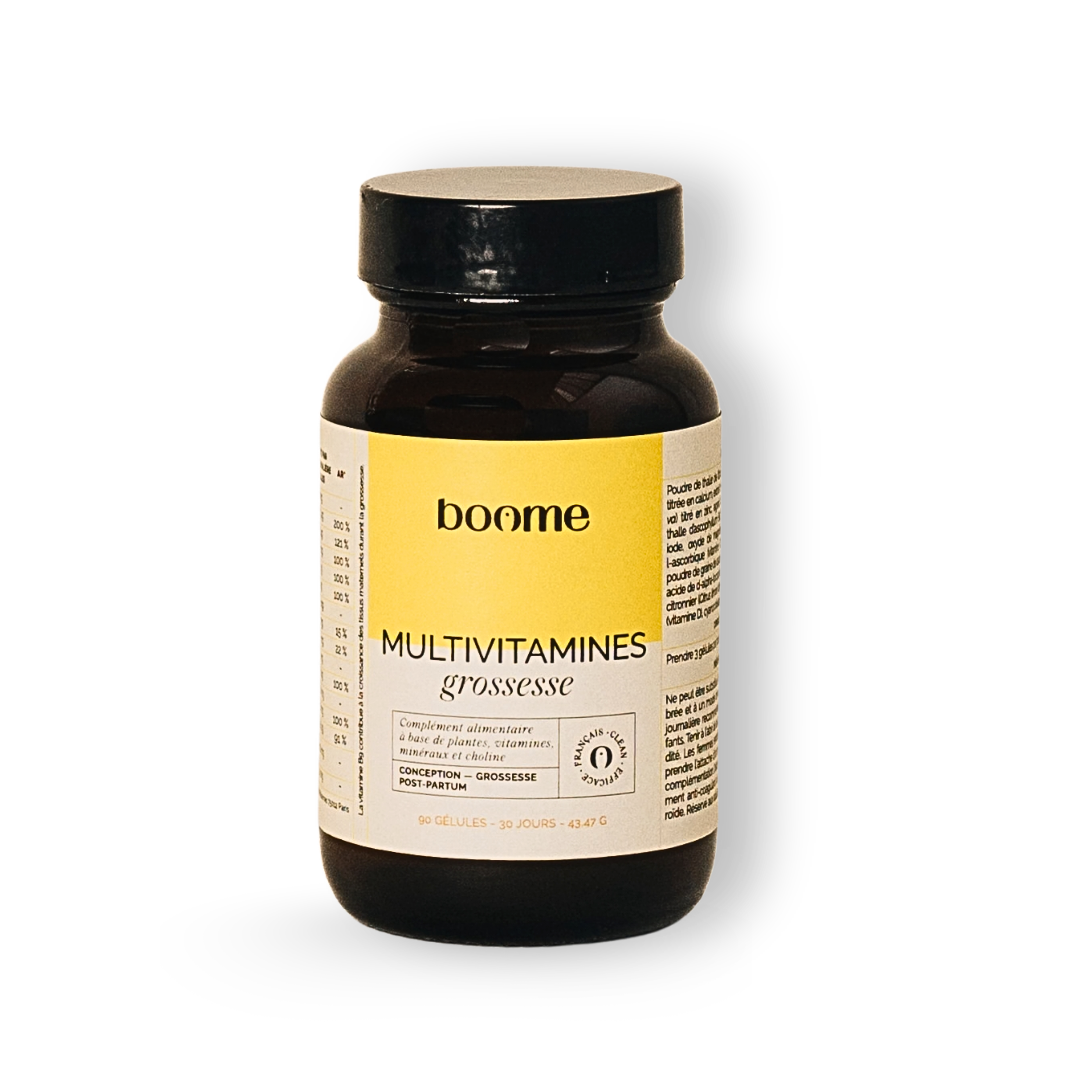
- Our bestseller, our pregnancy vitamins, are also taken after Detox, whether or not coupled with Baby Boost, and as soon as you desire to conceive. Thanks to them, you stock up on good vitamins and minerals, and increase your reserves of natural vitamin B9, which is assimilable by the body and replaces the synthetic folic acid generally prescribed a few months before becoming pregnant.
And for all those who want to know even more, we invite you to follow the Emancipées Instagram account, aka Laurène Sindicic, the queen of fertility who will make you love science classes again!
Produits associés



Produits associés
Read more

What to eat when pregnant during the holidays? How to boost your fertility thanks to the New Year and Christmas? We asked Blanche Rautenstrauch , naturopath and nutrition consultant, who has com...

Anaïs is 34 years old, works in tech, and is the mother of Iris, aged 4. She discusses with us her experience of motherhood, surprising, overwhelming, violent, which gave rise in her to a deep ...

